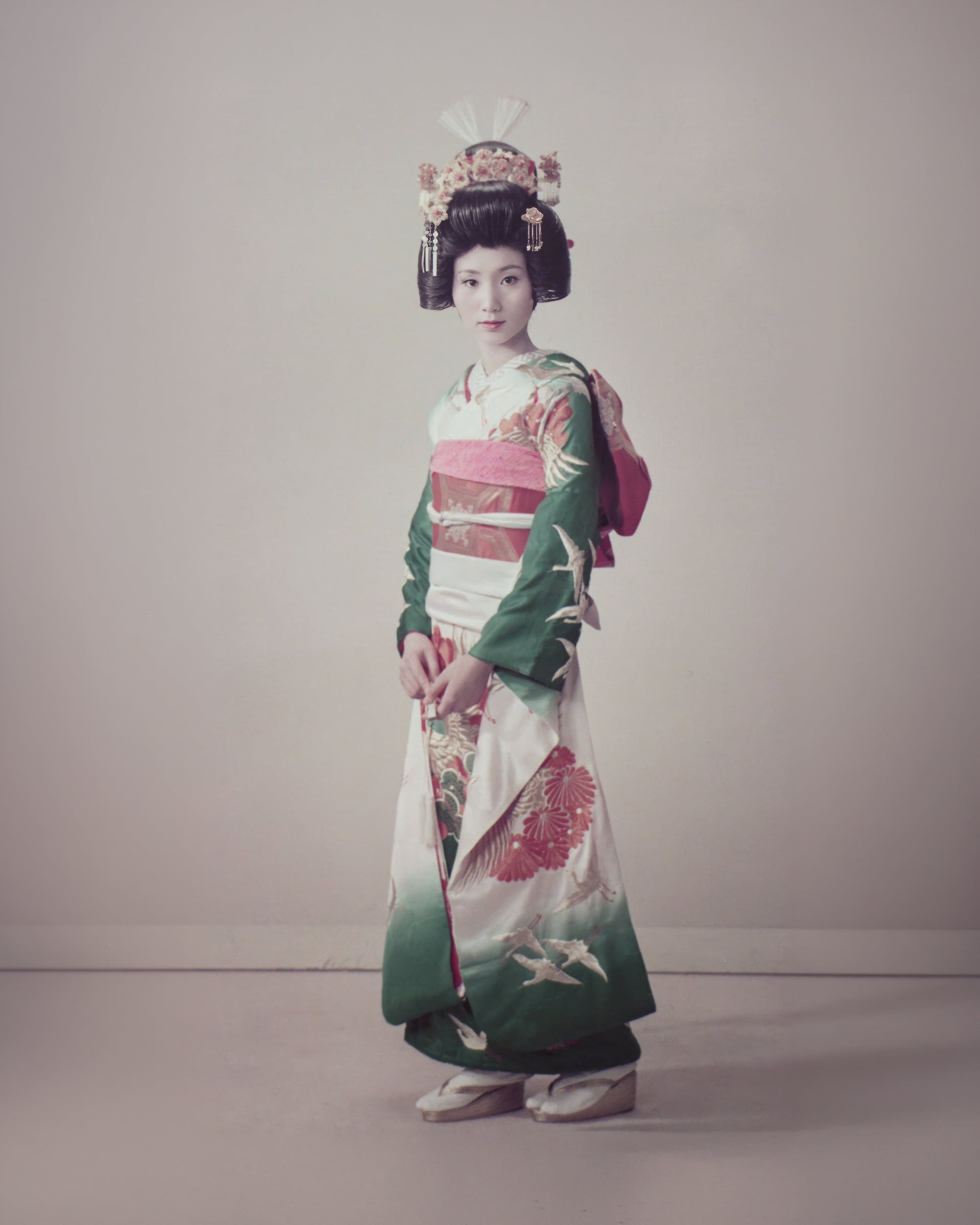
There is a photograph of my mum on her wedding day, taken in the 1970s. She stands against a studio wall in a beautiful green kimono with white cranes across the sleeves, red chrysanthemums low on the hem, and a formal hairstyle pinned with combs. The colours of the photo have drifted gracefully with age, bathed in soft pinks and greens. Everyone in my family has seen the photo, and mum gets no end of compliments for it.
For our tenth anniversary, Tom asked his friend and artist Fin DAC whether he would make a portrait of me. Fin lives in London, and as he paints murals and canvas work, his creations can be seen in cities all over the world. He works mainly in spray paint for his murals, and uses different mediums for his studio artwork, finishing each face with a mask of colour across the eyes, a signature that has become instantly recognisable.
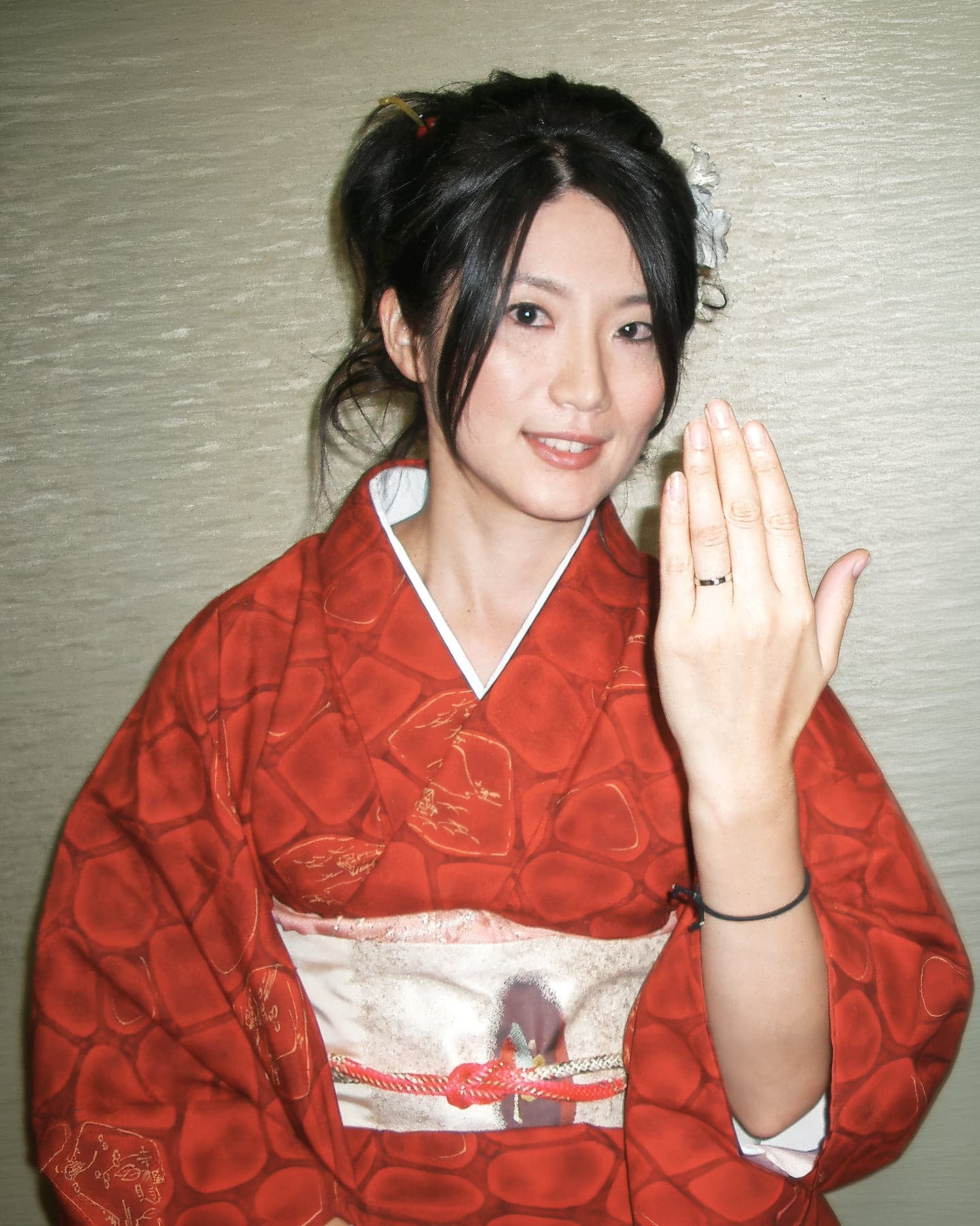
The day we married was in 2009, and that was the photo Fin referenced for this artwork. Tom sent Fin several photographs to work from, and my mum’s was among them. Fin came back with a wonderful idea neither of us could have anticipated: instead of just painting me from my own wedding photograph, he would also take my mum’s picture as a basis and have me wear the kimono she wore.
In his own words: “I wanted to use the photo as the basis for my piece but showing Rieko in her mum’s wedding dress instead.” He politely asked first whether this would be disrespectful, but it certainly was not. My mum was delighted, and more than a little honoured that Fin liked her wedding photo. Tom left the whole idea to Fin and saw nothing until it was finished.
“Two wedding photographs, my mum’s and mine, and Fin made one picture out of both.”
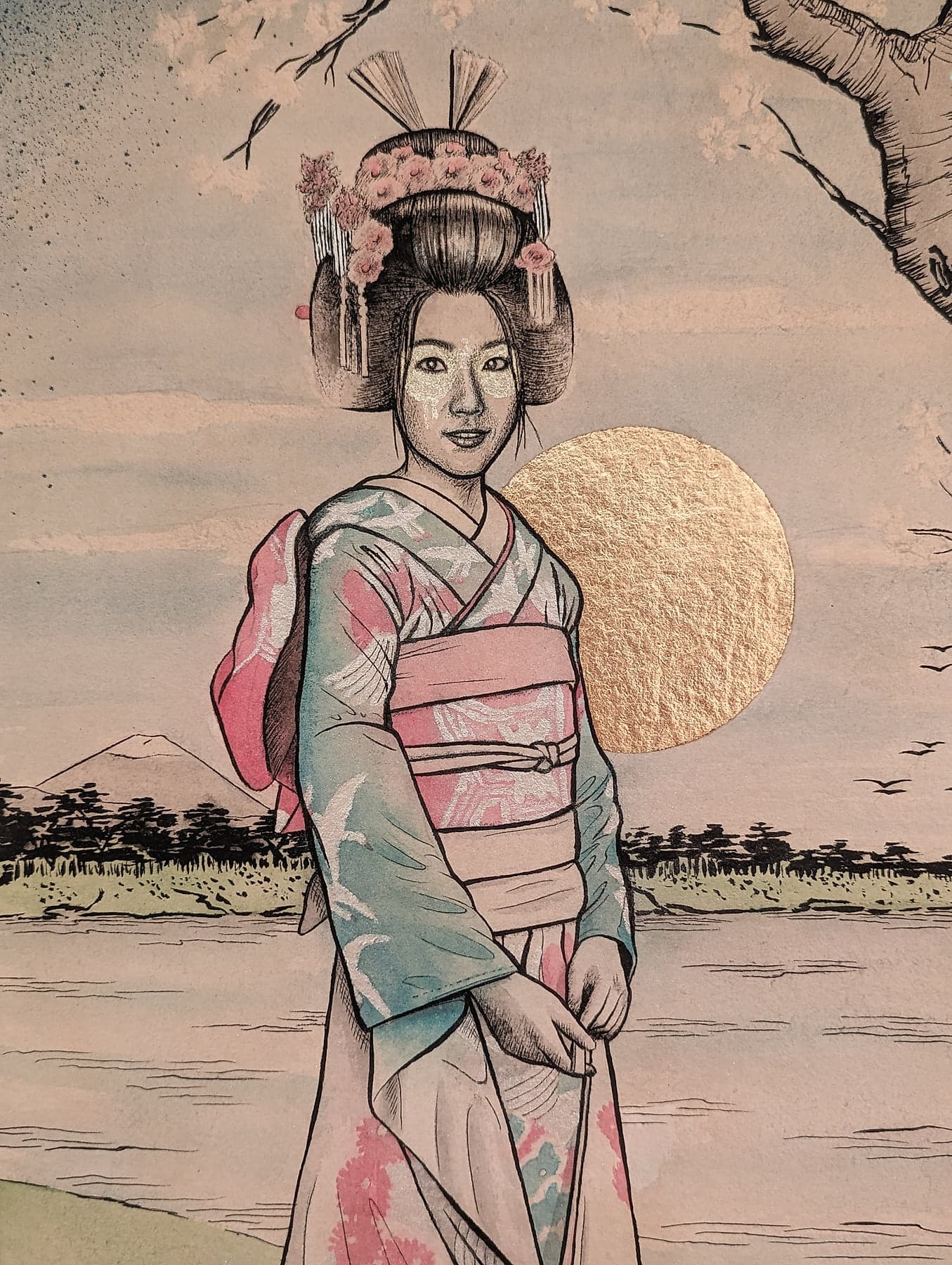
The making took Fin somewhere new. One of his early loves in art was the Japanese woodblock print, and he knows the old masters well: Kikugawa Eizan, Torii Kiyonaga, Utagawa Kunisada, and Kitagawa Utamaro. This piece was the first time he had properly used watercolour, Japanese ink and brush, masking fluid, and tea-staining to age the paper. He finished it with metallic paint and gold leaf.
When I first saw it finished, what I noticed straight away was the influence of those old woodblock prints. The kimono is the one from mum’s photograph, featuring the cranes and all the little details redrawn in green and rose, while the face is mine from our wedding day. Behind me there is a sun made of real gold leaf, alongside a cherry branch, a line of pines, a mountain, and the water, all culminating in the mask across my eyes.
I loved the concept as soon as Tom told me about it, and I love the finished piece even more. My favourite part is the gold; because it is laid on thickly enough to hold texture, when the afternoon light comes through the blinds and catches the leaf, the sun in the picture truly shines, filling me with quiet happiness. It looks a little different depending on the gentle shift of light and the time of day.
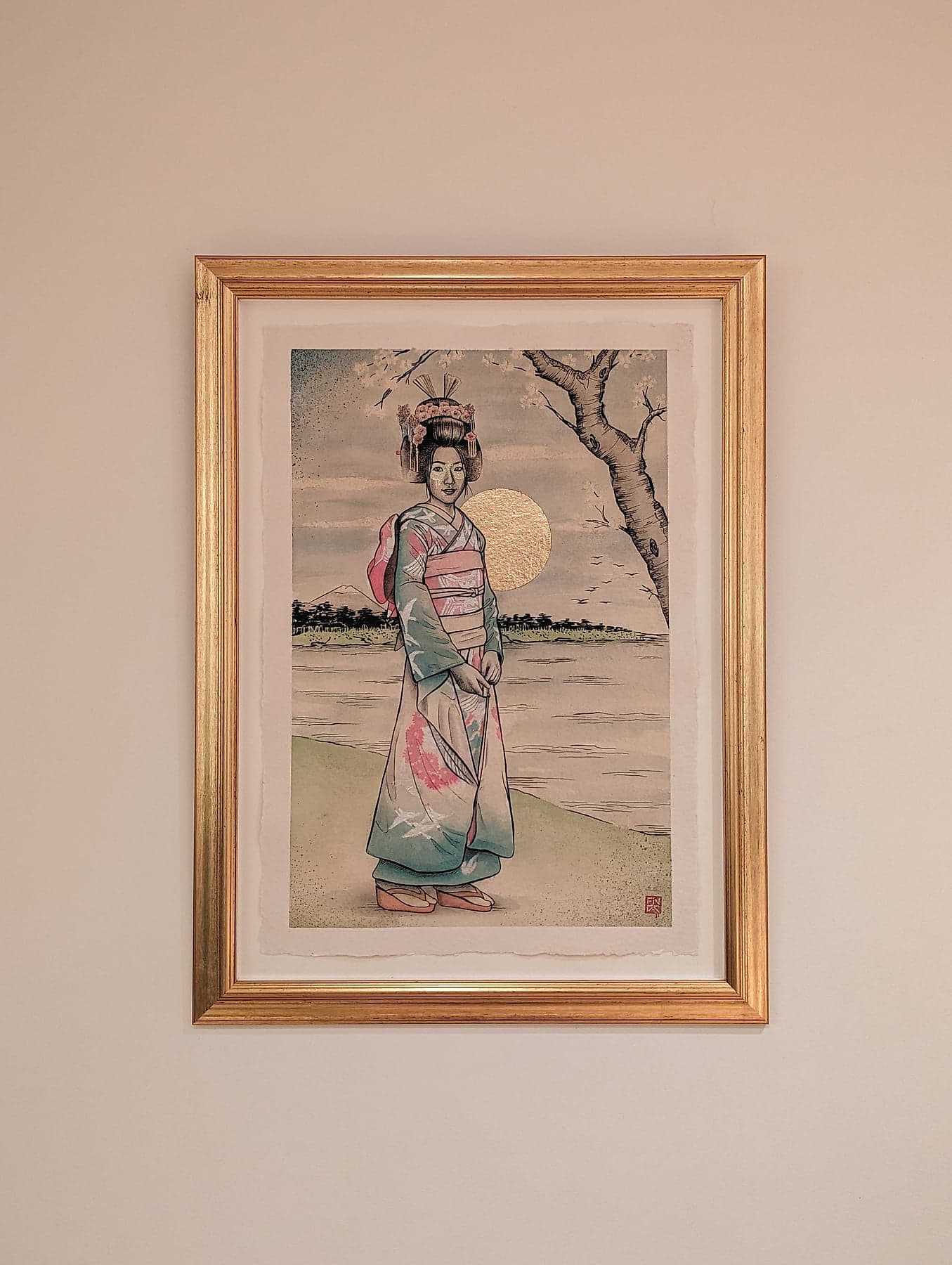
Then came the second piece. Fin had kindly promised early on that he would make a version for my mum, and in December 2023 we went to his studio to collect it. We spent the afternoon hearing about what he had coming up, surrounded by all his amazing works. I always leave his studio wanting to go straight home, be creative, and return to the stories I have been drawing for the last several years. Fin is such an inspiration in so many ways, and I am deeply grateful to know him and watch how he creates his wonderful art.
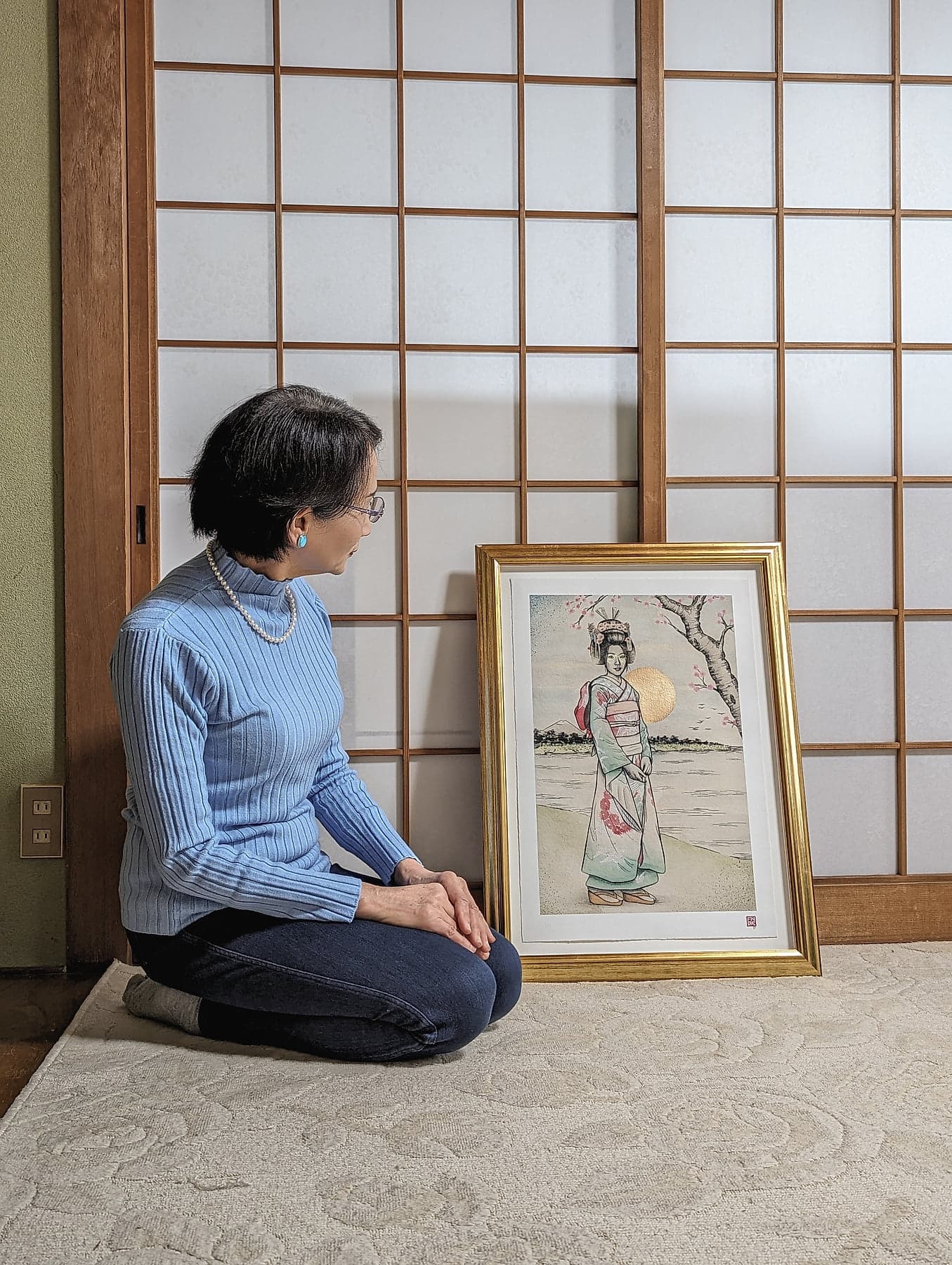
My mum’s piece is a hand-finished print, worked over by hand once the printing was complete. Fin felt parts of it had come out better than the original, with the petals in particular holding more colour, and he said so plainly, which I loved hearing. I was so happy with the way they both carry their own unique beauty. We chose the frames together: a lovely, simple gold style, both made in London so the pair would match.
We carried mum’s piece to Japan in May 2024 and gave it to her at the family home. What we had not expected was the profound magic of having two of them. I live in London and my parents live in Japan, and we see each other about once a year. Now, the same image hangs in two homes thousands of miles apart, and both of us are in it.
When I look at mine, I am looking at her kimono, and when she looks at hers, she is looking at me. It feels rather poetic, and such a wonderful idea from Fin to have put such thoughtful care into the whole concept.
My mum says the same about hers, noting that she notices the gold when the light changes in the room and it makes her think of us. In Japanese, we have a word for this kind of connection: Musubi (結び) means to tie, like tying a knot, and it is also used for the way people and things end up bound together. What his picture tied is our Kokoro (心), the one word Japanese uses for what English separates into heart, mind and spirit. Two of the same picture, one in London and one in Japan.
Words
Rieko Maeda