We ordered the knife in a hardware store in Japan, a shop full of character. We'd been drawn in by its friendly owner, the shelves full of interesting little bits and pieces, and the knives of every kind hanging on the walls. It had this wonderful authentic feel to it. The owner, it turned out, had visited the Shigefusa forge once, some thirty years ago, when he and two senior colleagues in the trade toured Japan's blacksmiths through the local wholesalers. Ever since, through his ties with those wholesalers and fellow merchants, he has brought Shigefusa knives to his customers. We asked if it would be possible to place an order. It could take years, he said. But as the conversation continued, the owner agreed to put our names down on a waitlist.
Five months later, back in the UK, we received word that the knife was ready. For a Shigefusa, where the wait is usually measured in years, that almost never happens. Our luck was timing: Shigefusa happened to be making a knife to exactly the same specification as ours, and made one more alongside it. We only visit Japan once a year, so by the time we went back to Kyoto to collect it, more than a year had passed since we'd ordered. The owner first brought out the Shigefusa box, carefully, to show us.
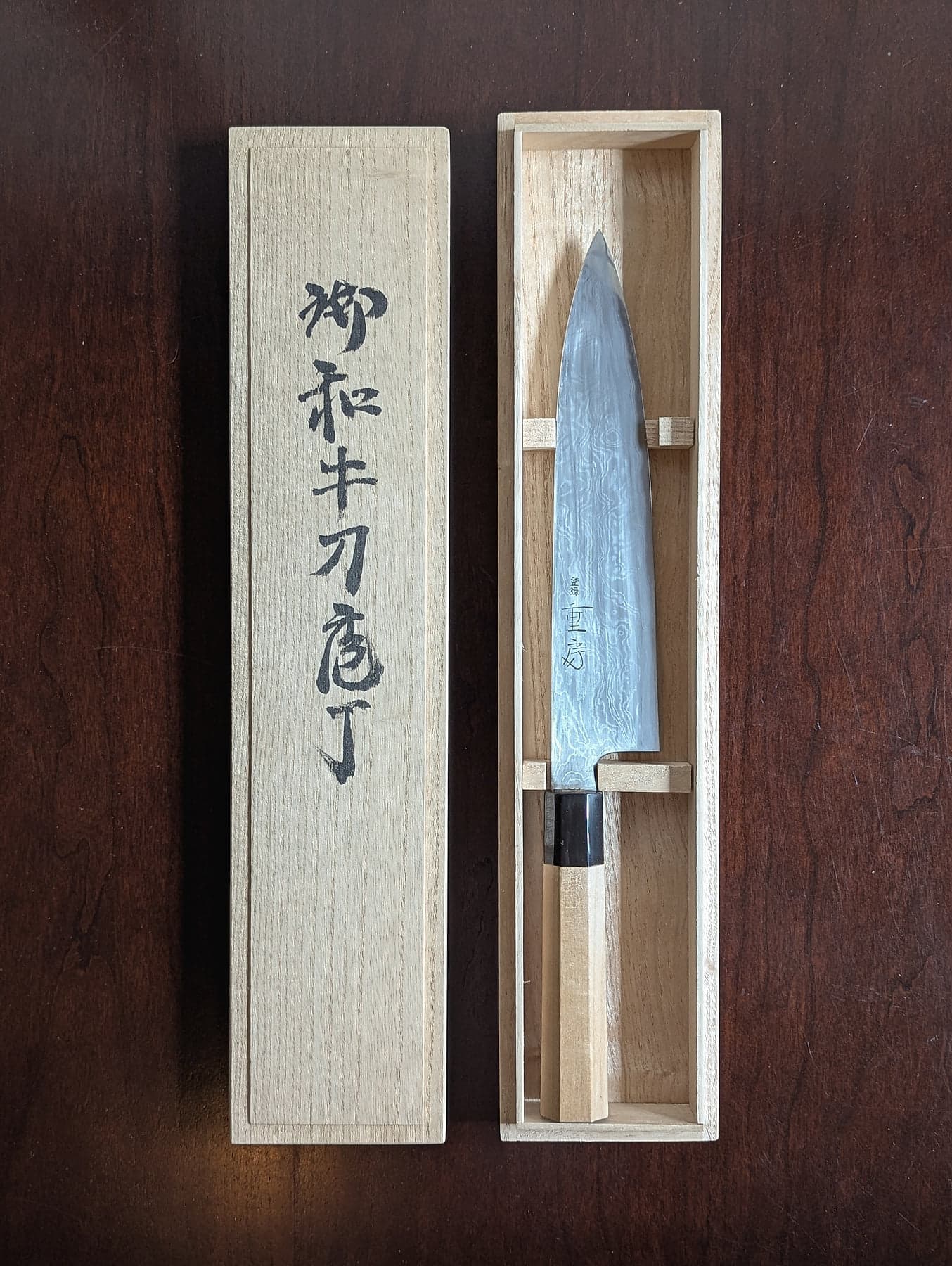
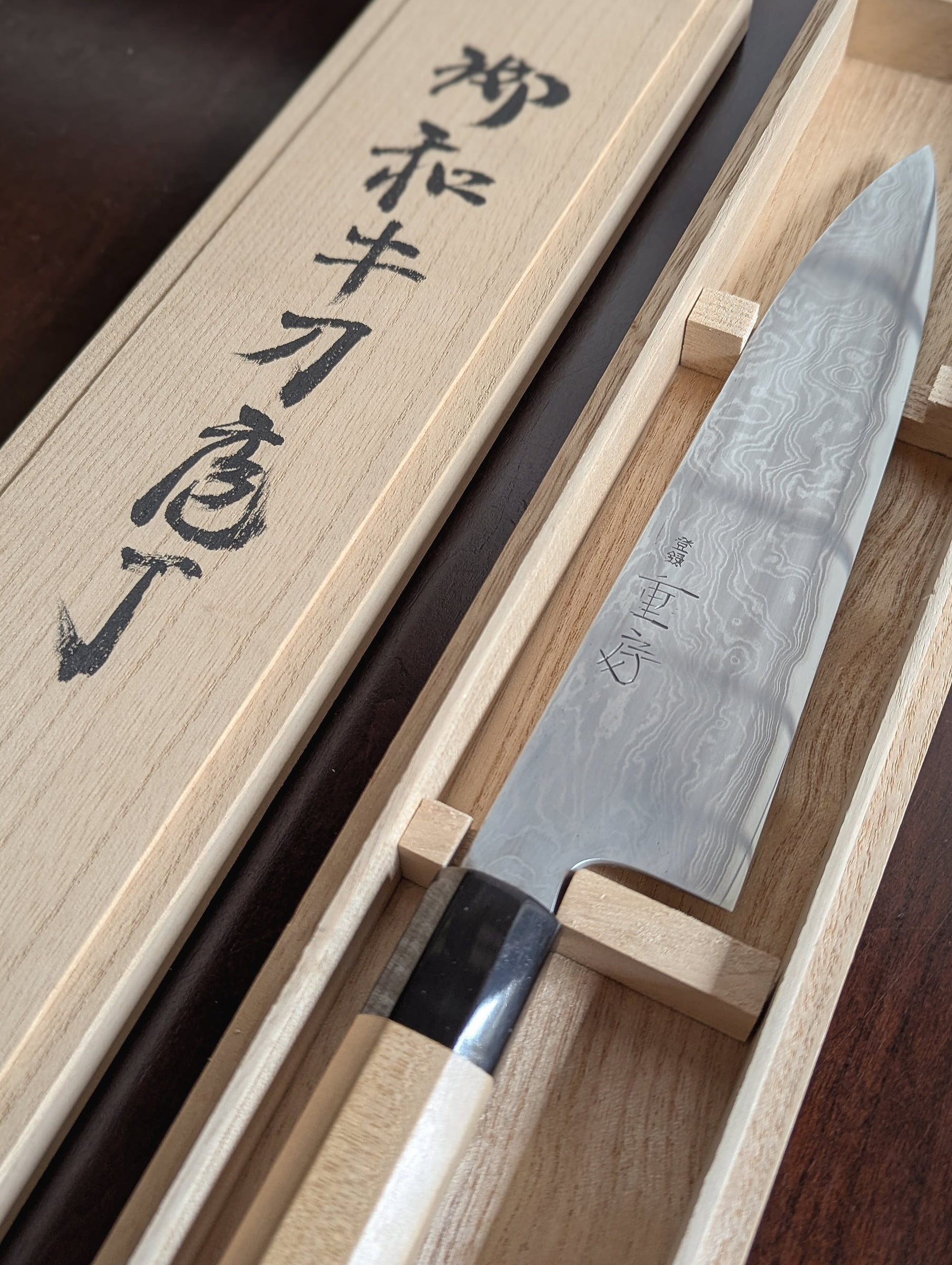
The box is kiri wood. Paulownia, the same timber used to store kimonos and samurai swords, chosen because it breathes with the seasons. Expanding in humidity, contracting in dry air, protecting what's inside without suffocating it. On the lid, six characters brushed in sumi ink: 御和牛刀庖丁. Honourable wa-gyuto kitchen knife. The formality of it. As though the box itself understood what it was carrying.
The lid came off, and what appeared was a work of art with a soul in it. A Shigefusa kitaeji wa-gyuto, 210 millimetres of hand-forged Swedish carbon steel, resting on wooden supports.
Once he had talked us through it, he wrapped the box in paper with that particular Japanese precision. Every fold exact, every edge aligned.
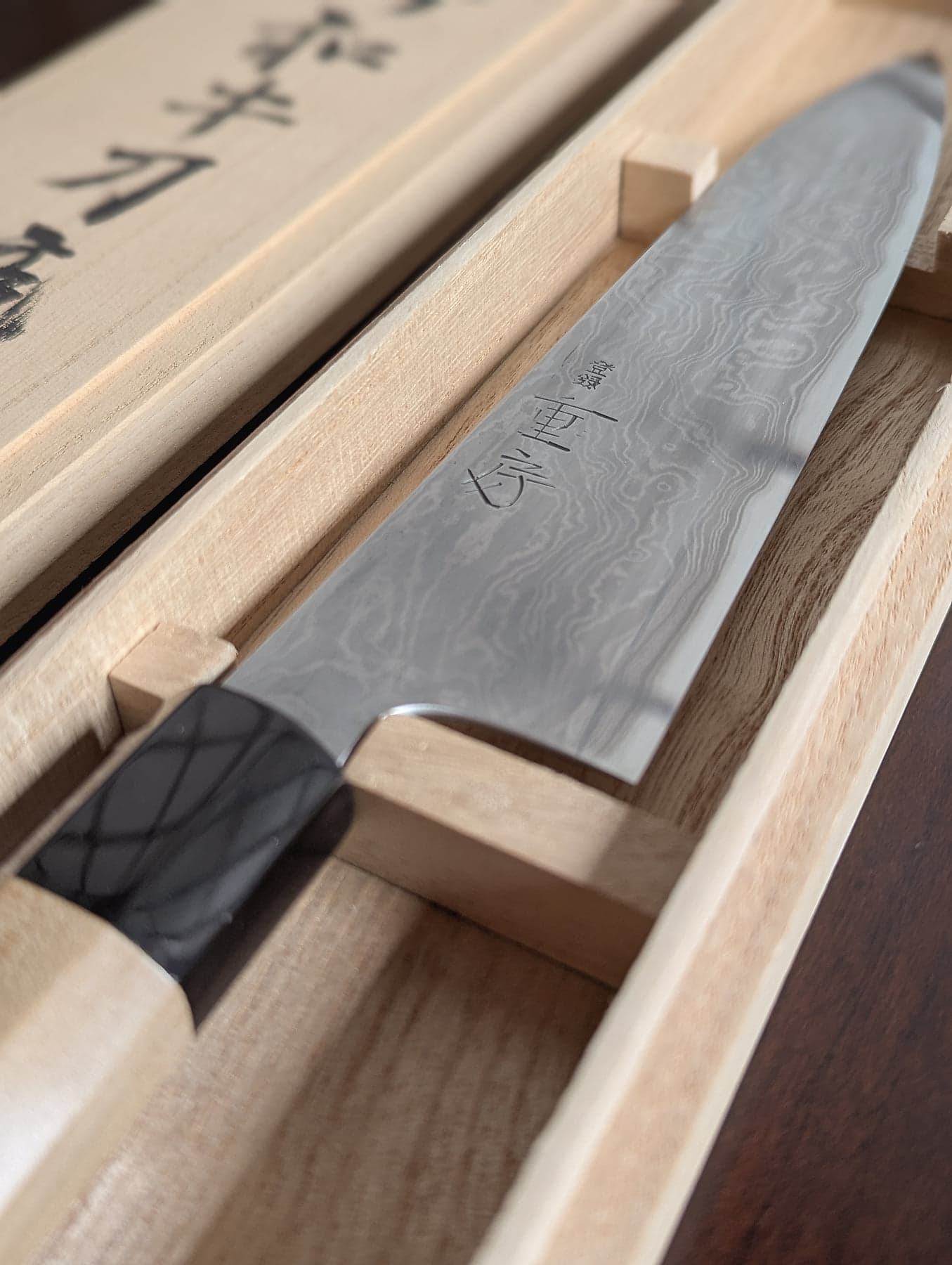
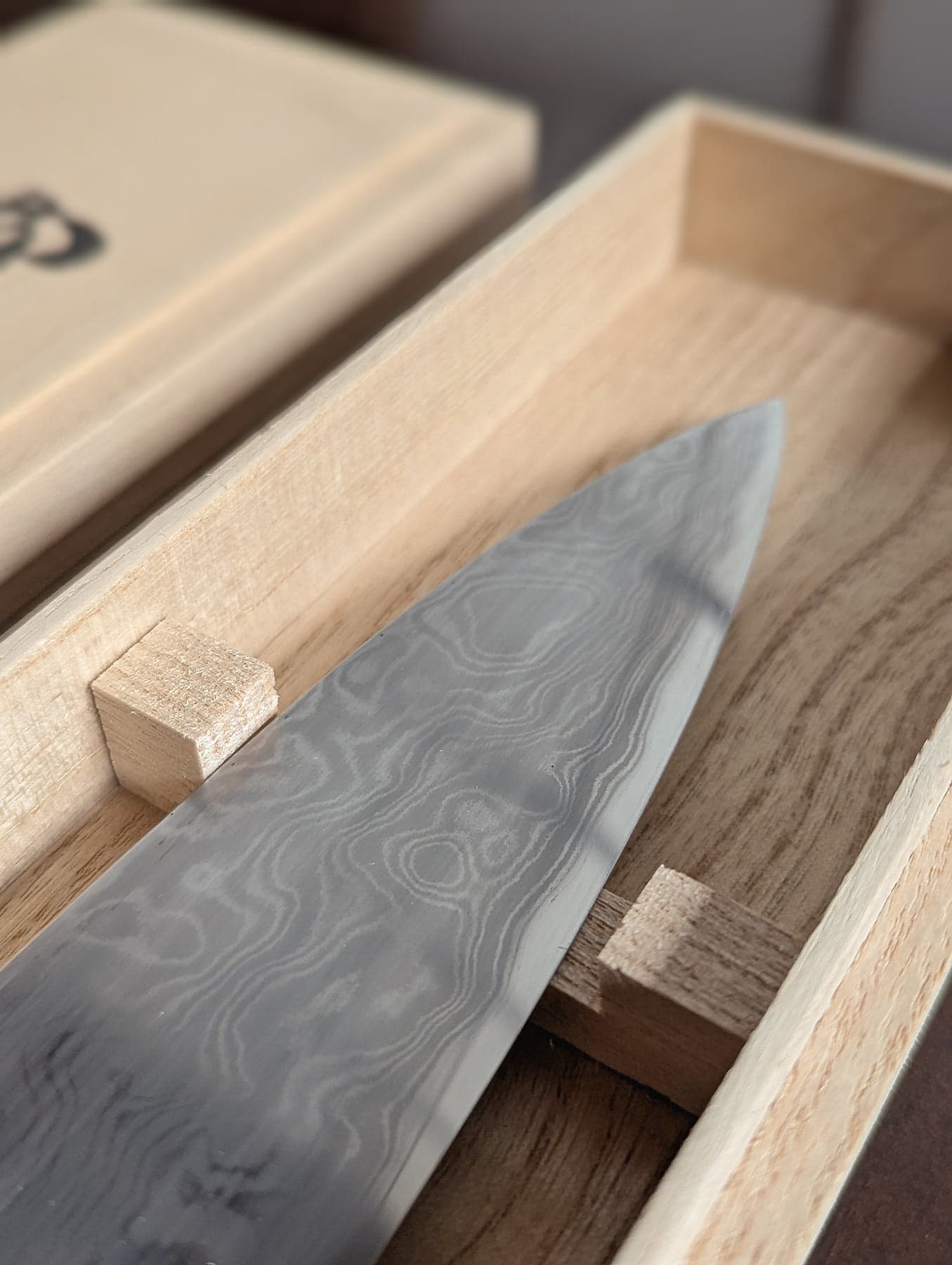
Later, back at my wife's family home, we opened the kiri box again and looked at the knife properly. The way the light catches the kitaeji pattern, layers of different steels forge-welded together, folded, hammered, and ground until a beautiful, smoke-like pattern flows across the surface. Every Shigefusa blade has a different pattern, not by design but by nature, the same way no two pieces of wood have the same grain. It is a breathtakingly beautiful knife.
Near the heel, on the face of the blade, the maker's mark: 重房, Shigefusa, with the smaller characters 登録, registered, above it. Set in sure, unhesitating lines, it is the mark of the people who make these knives.
Look closely at the spine and you can see where it's been shaped by hand. Not machine-ground to a uniform thickness, but worked with files and stones until the taper feels right under the fingers. The choil, where blade meets handle, is finished clean and smooth. The buffalo horn ferrule sits flush against the ho wood handle with no gap, no glue marks, no imperfection in the joint. These are small details, and they are also the entire point.
The handle carried a kindness from the shop owner. Because I'm left-handed, he let us know it had been fitted as an octagonal handle with a water buffalo horn ferrule, which sits equally well in either hand. And there in the shop he resharpened the kobazuke himself for a left-handed cut, the fine secondary bevel at the very edge, then gave the blade a thin coat of machine oil. A knife like this passes through more hands than its maker's before it reaches yours.
Shigefusa is the mark on the knives forged by the Iizuka family in Sanjo, Niigata prefecture, a region that has produced metalwork for over four hundred years. Today the founder Tokifusa Iizuka's two sons, Masayuki and Yoshihide Iizuka, have taken over, and make the knives together in the family workshop. They don't have a website. They make what they make in the quantities their hands and their days allow, and when the knives are finished, they reach knife shops across Japan through a number of wholesalers. Orders outpace what the forge can make, and waits of several years are not unusual.
“They make what their hands and their days allow, and the finished knives reach knife shops through the wholesalers.”
In a world that has optimised almost everything else, this wait feels impossibly long. It isn't meant as a statement. Shigefusa isn't making a point about slow living or mindful consumption. He's simply making knives the way they have been made for generations, at the speed the process requires. We may find the wait long, but looking at this knife again, it's easy to see why Shigefusa's knives are so sought after. And it reminded us, with real gratitude to the shop owner, how lucky we had been: the knife finished in five months, and in our hands a year after we ordered it.
Since ancient times, the Japanese have believed that a life force resides in all things. Yaoyorozu no kami: the understanding that spirit inhabits everything, not just living beings but rivers, mountains, and objects made with enough care and accumulated skill. A blade that a single person spent days forging, shaping, polishing, and signing carries something of the person who made it into the life of the person who uses it. When we collected ours, the shop owner reminded us that Shigefusa wants his blades to be used, not kept for display.
From ordering it to holding it, a little over a year. That was a great piece of luck, and it was also, it turns out, exactly the right amount of time. Long enough to forget about it, then remember. Long enough to picture holding it, then stop picturing. Long enough that when you finally stand in that same characterful shop and the lid comes off, you take in its details slowly. You pay attention. You notice the oil, the wood, the weight, the grain in the steel, the maker's name on the blade. You notice everything. A truly memorable experience.
Words & photos
Tom Vining