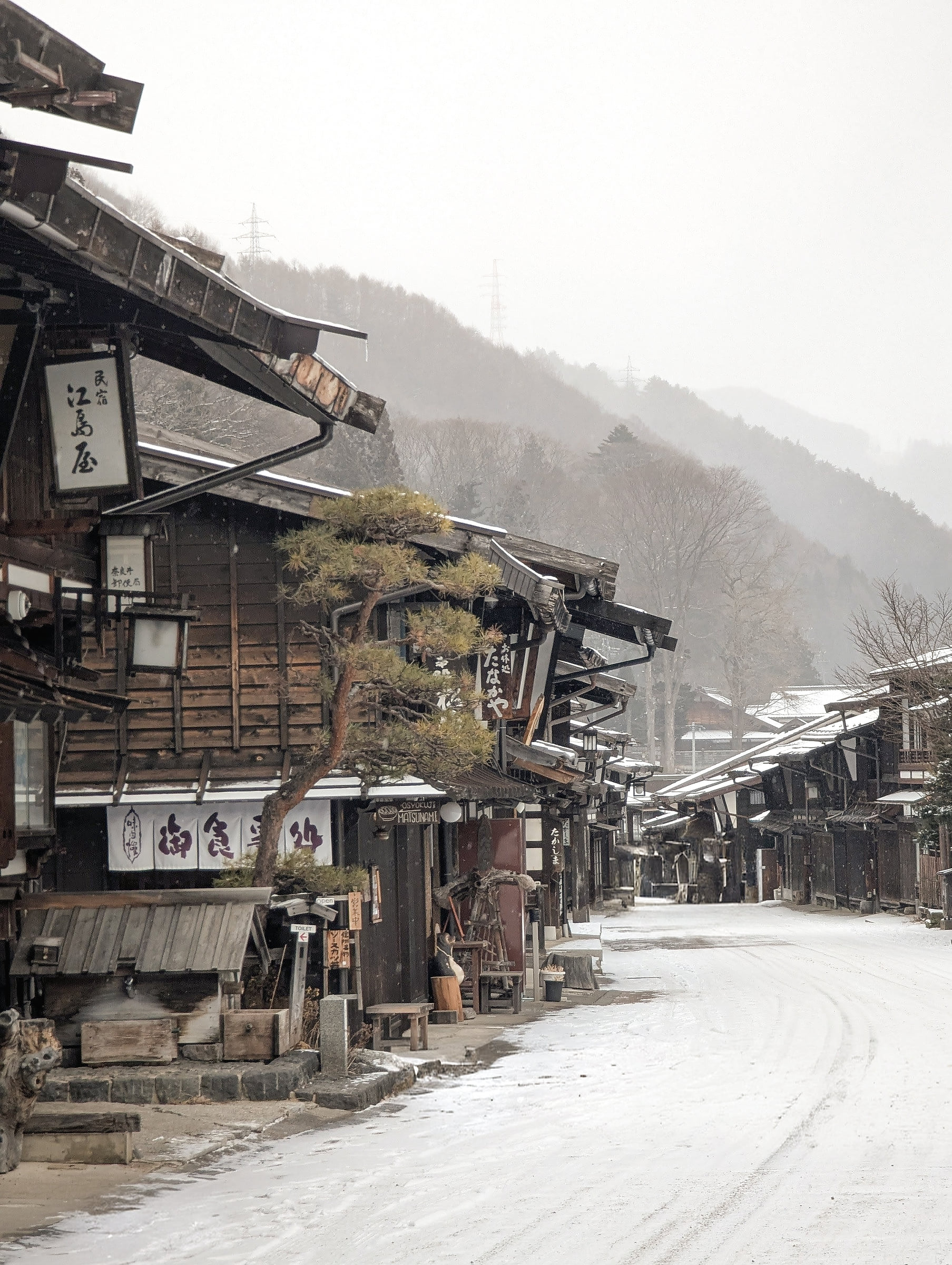
The snow had been falling for hours when we arrived. Not the heavy, committed snow of a storm, but the fine, silent kind that doesn’t seem to accumulate until you look down and realise the road has disappeared. Narai-juku sat in it like a photograph of itself. Dark wooden buildings on both sides of a single street, a kilometre long, the mountains behind them dissolving into white. Minus ten, and dropping.
Almost nobody was there. A few figures in the distance, moving slowly between buildings, but the street itself belonged to the snow. Not surprisingly, given the temperature.
Narai is the longest of the sixty-nine post towns along the Nakasendo, the mountain route that connected Edo to Kyoto through the interior of Honshu. Travellers stopped here during the feudal period to rest, eat, and prepare for the Torii Pass. The buildings they slept in are still standing, not reconstructed and not preserved behind glass, but still standing because nobody tore them down. The latticed facades, the overhanging second floors, the indigo noren hanging in doorways of shops that may or may not be open. Four hundred years of continuous use, worn smooth by time the way a wooden step is worn smooth by feet.
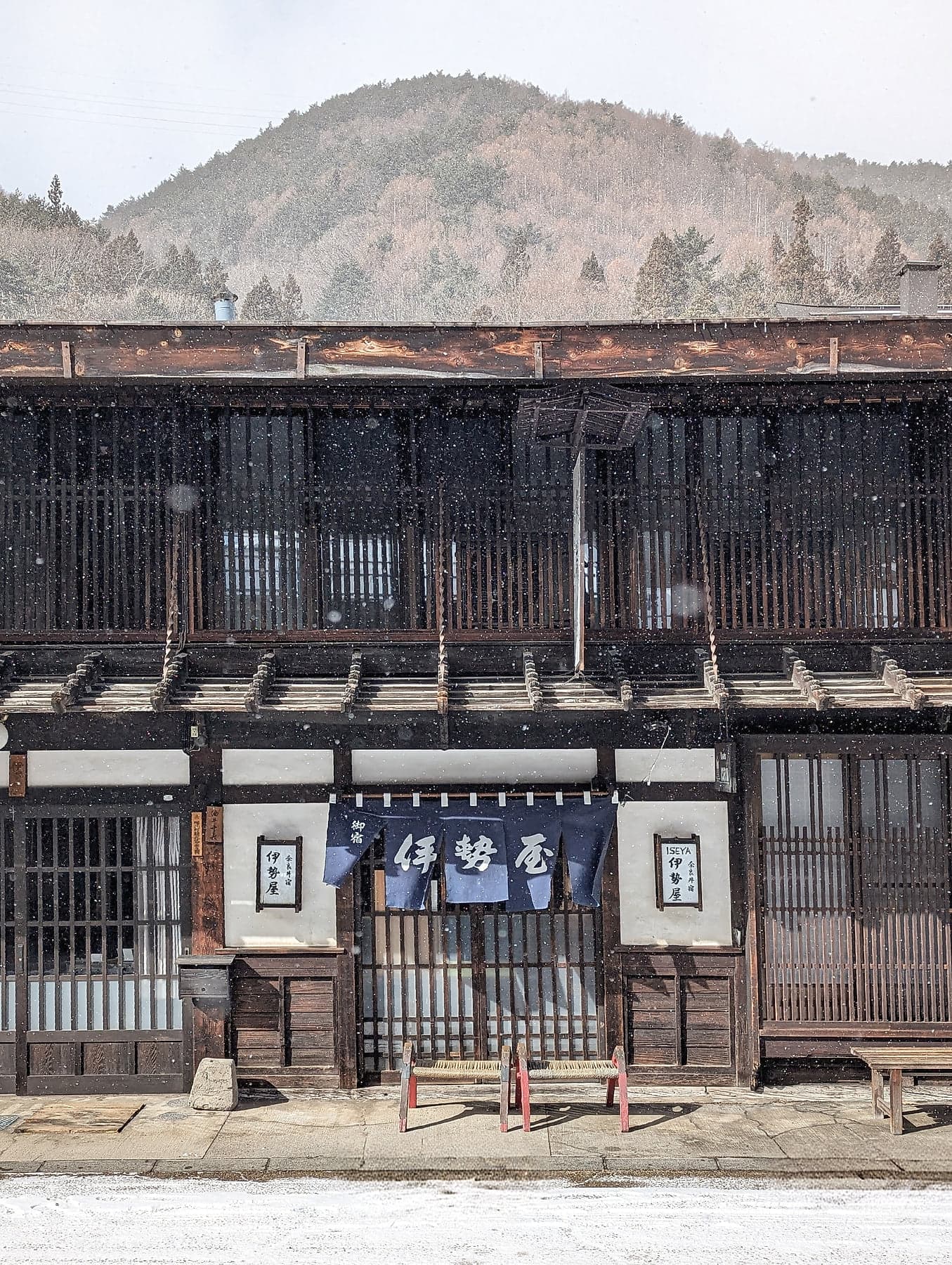
We walked the length of the town silently, quite in awe, as if we were in a dream or something. Snow collected on the eaves and on the carved wooden signs. A pine tree, trained flat against a building, held its branches perfectly still. Somewhere, water ran beneath the road in the channels that have carried it since the Edo period. You could hear it under the silence, a faint continuous sound like a building breathing.
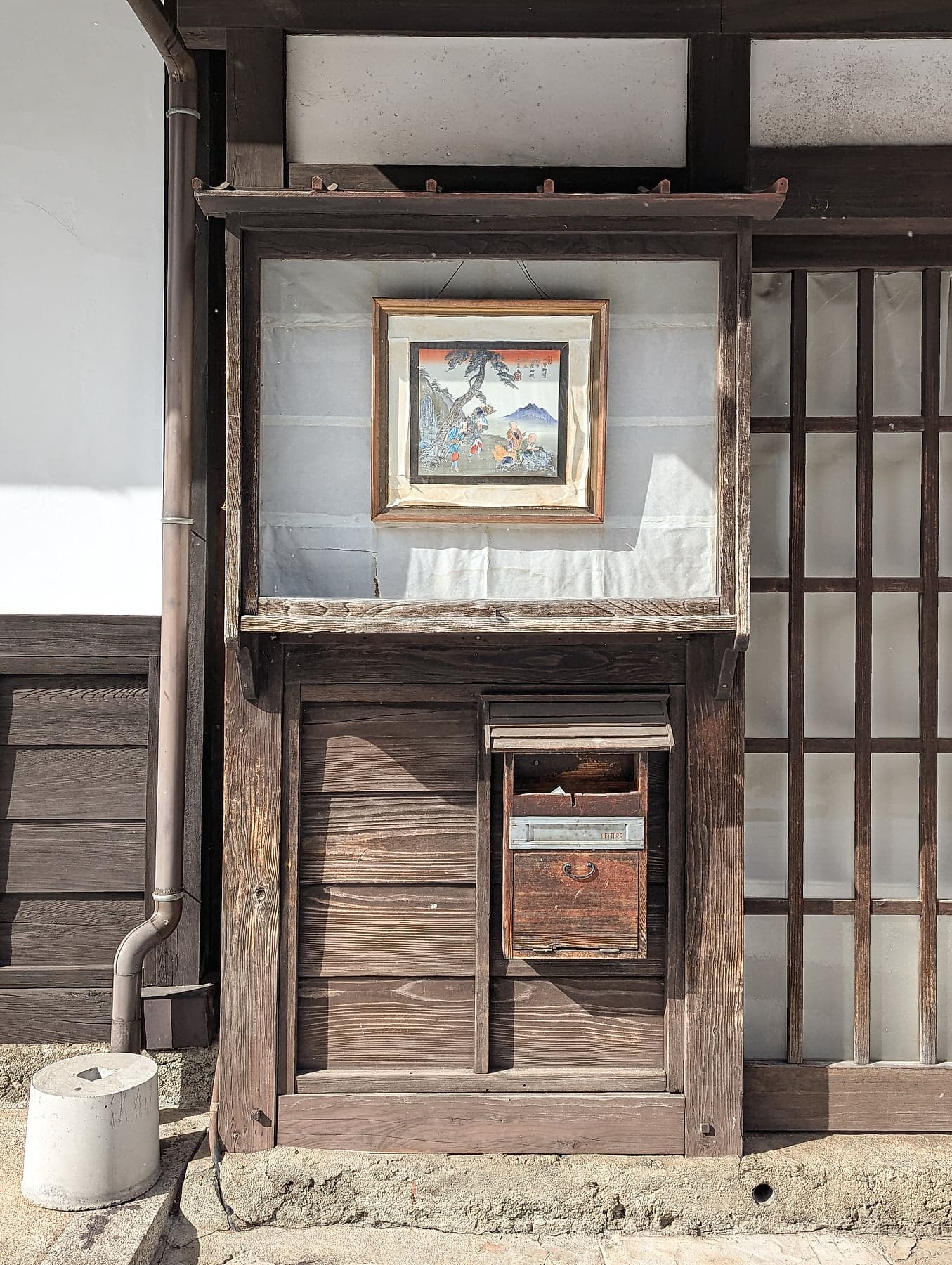
Halfway along the street, a framed ukiyo-e print sat in a glass case above a wooden letterbox on the front of a house. A small landscape: mountains, travellers, a bridge. It could have been a scene from this exact road, painted two centuries ago by someone who stood where I was standing and saw roughly what I was seeing. The print was not in a museum, not labelled or lit, but simply there, in the place where someone had put it, part of the fabric of the building the way the lattice and the letterbox were part of it.
This is what Narai does. It removes the boundary between the historical and the ordinary, with no entrance fee and no audio guide explaining what you are looking at. The town is simply continuing its past rather than performing it.
“In a place with no noise and no agenda, time becomes unreliable.”
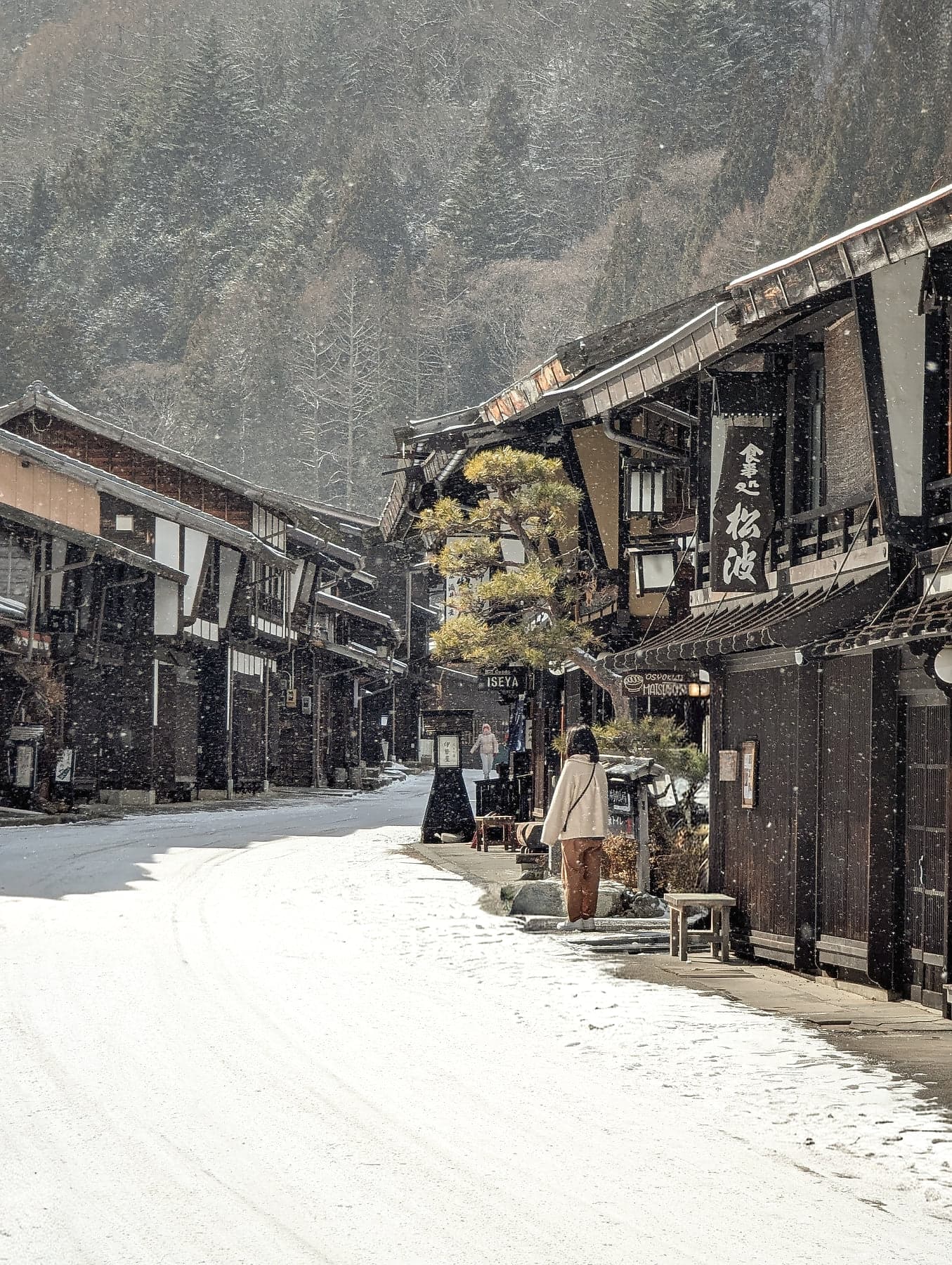
The snow thickened. The mountains behind the roofline faded to grey outlines. A figure appeared at the far end of the street, walking slowly, coat pulled close. They passed us without a word and turned a corner. A minute later, it was as if they had never been there.
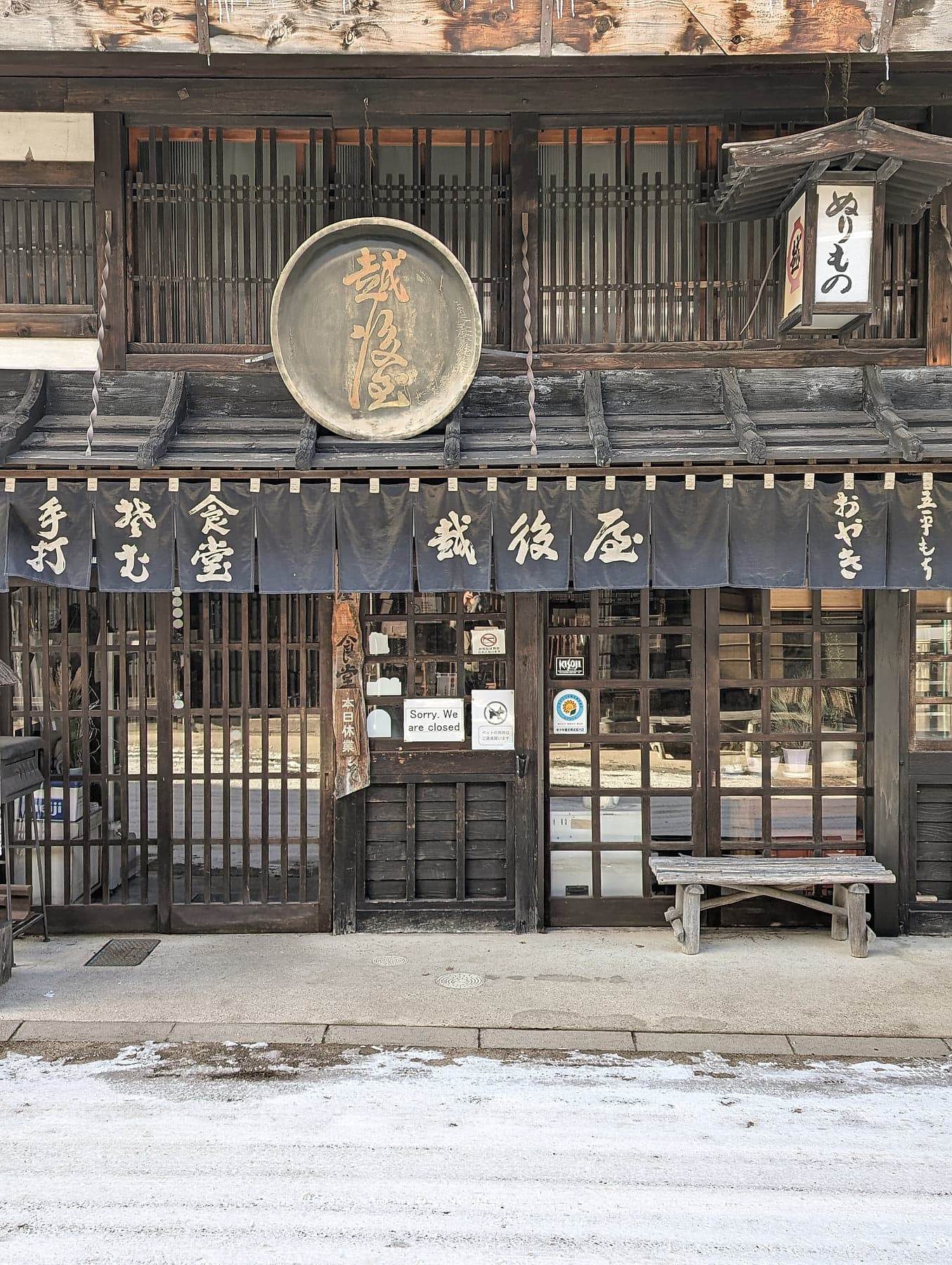
I stopped in front of a shopfront with a round wooden sign and dark noren. The bench outside was dusted with snow. The door was closed. I stood there for what might have been two minutes or ten. In a place with no noise and no agenda, time becomes unreliable. Not in a mystical sense. In the plain sense that your internal clock, which usually calibrates itself against conversations and notifications and the rhythm of other people’s movement, has nothing to calibrate against. You are left with the snow and the wood and the sound of water you can hear but not see.
At some point, standing still in the middle of the street, I watched the snow being blown sideways across the rooftops. The dark wood, the white sky, the silence, the cold on my face. And something happened that I didn’t expect. My eyes filled with tears, not from sadness or the wind but from something closer to joy, though that word doesn’t quite cover it. Complete absorption, no distance between me and what I was looking at. For a few seconds, there was no observer and no scene. Just the snow and the wood and the cold and the fact of being there.
There is a tendency, when writing about places like this, to reach for large claims. To say that the place teaches you something, or changes you, or reveals a truth about the way we live now. Narai doesn’t do any of that. It is a street with old buildings and, on the day we visited, a lot of snow. What it offers is time rather than a lesson. An hour, maybe two, in which nothing happens and nothing needs to. The buildings stand, the snow falls, the water runs, and you walk or you stop walking.
We had four hours before our train back to Matsumoto. At minus ten, four hours is not something your body lets you forget. Twice we took refuge. First in a small tea house, where a woman brought us matcha in ceramic bowls and we sat by the window watching the snow pile up on the street outside. Then, later, in a soba restaurant, where the noodles arrived in a hot broth that made the cold feel like a distant rumour. Both times, the warmth did something physical. Circulation returning to fingers and feet, the particular pleasure of thawing that only exists because you were frozen first. You don’t appreciate a warm room the same way if you haven’t earned it.
We walked the street twice in the end, once in each direction. It looked different on the return. The same facades, the same snow, but the light had shifted and the mountains on this side had reappeared briefly before the next band of cloud arrived. Our footprints from earlier were already filling in.
On the train back, the Kiso Valley opened up below us, the river grey-green and fast, the hills covered in hinoki. We were both quiet, still thawing. Narai is not a place that performs its own history for visitors. It has simply continued on its own terms for so long that the question of what it is for has stopped being relevant. It is for the people who live there. If you happen to walk through it on a January afternoon, that is incidental.
Words & photos
Tom Vining